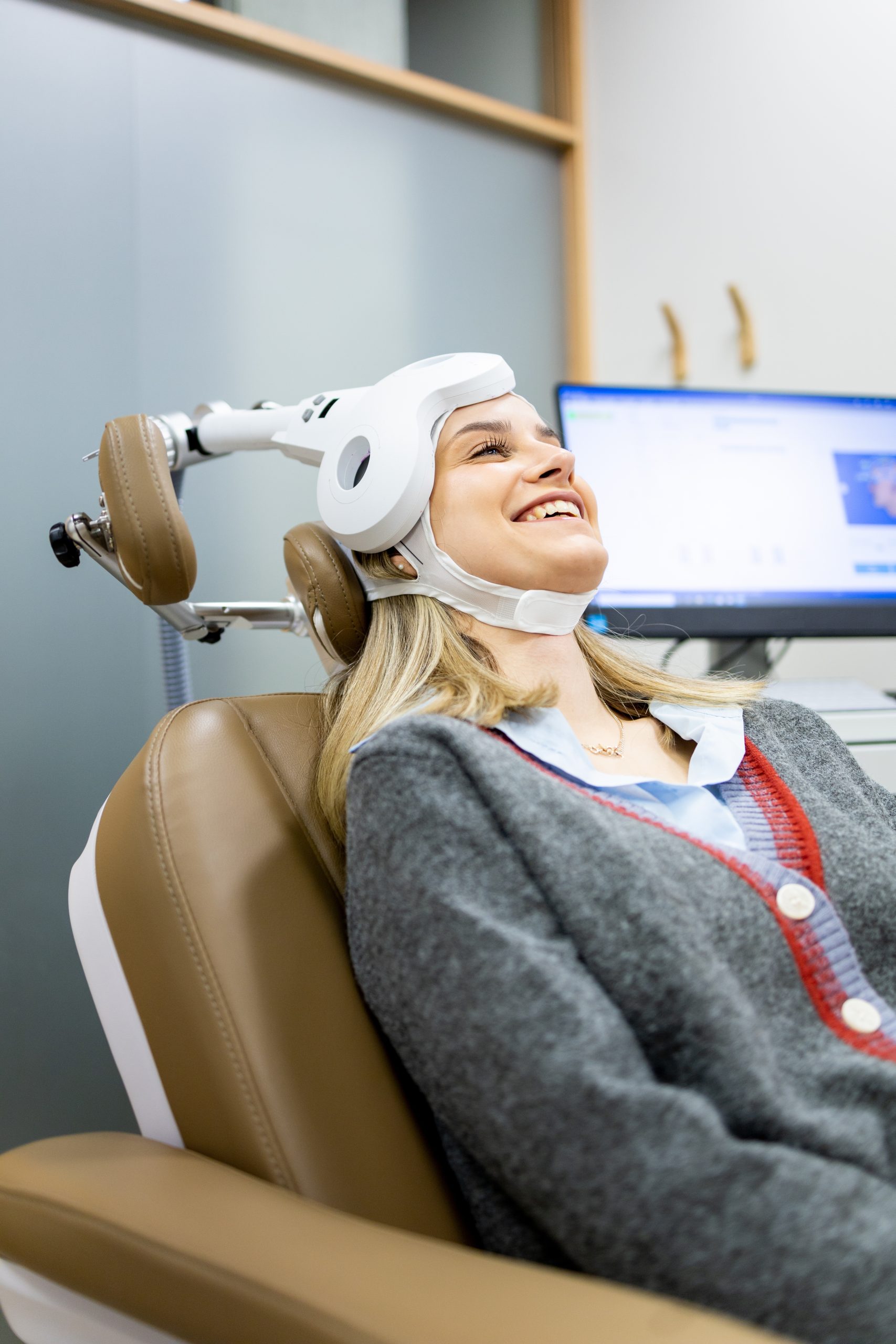
Most patients describe TMS therapy as a light, repetitive tapping or knocking on the scalp – much like a woodpecker gently drumming – paired with a clicking sound and a gentle tightening of nearby muscles. These magnetic pulses target the brain regions involved in mood regulation. TMS requires no sedation, needles, or medication, so you stay fully awake and alert the entire time.
At Mentable in Charlotte, NC, patients often say the experience is far easier than expected. Our team fuses TMS with other approaches, offering non-medication treatments for conditions like major depressive disorder (MDD), anxious depression, and OCD.
Knowing what happens at each stage takes the mystery out of treatment. TMS is a structured, repeatable process, and most nervousness fades once you’ve had a session or two.
Your journey begins with a comprehensive psychiatric evaluation. Our experienced provider, Camellia Douglas, reviews your mental health history, current symptoms, and past treatments to confirm that TMS treatment is a good fit – especially if you’ve tried medication for depression or OCD without relief.
At your first appointment, the provider maps your treatment to find your “motor threshold.” The coil is placed against your head and delivers short pulses until your thumb or fingers twitch slightly, identifying the motor cortex and confirming the right strength and position. Mapping only happens at the beginning; your settings are then saved for future visits.
To prepare: eat normally, take your usual medications unless told otherwise, and wear comfortable clothing. There’s no downtime, so you can drive yourself.
You’ll be led to a comfortable, private room and seated in a specially designed reclining chair. The magnetic coil rests gently against your scalp, usually over the front-left area of your head.
Preparation: You’ll remove any magnetic-sensitive items, such as jewelry. Earplugs are provided, as the machine makes a loud clicking sound with each pulse, similar to an MRI.
Coil Placement: The coil is placed against the predetermined treatment area.
Treatment Begins: The machine delivers rapid magnetic pulses in short bursts followed by brief rest periods – this is when you’ll feel the tapping sensation.
You stay awake and alert the whole time. Many patients read, watch TV, listen to music, or simply relax, and a member of the care team stays nearby throughout. Sessions typically last between 3 and 40 minutes, depending on the protocol – traditional rTMS runs longer, while newer theta burst stimulation (TBS) can be much shorter.
Once your session ends, you can drive yourself home or back to work and resume normal activities immediately. There’s no recovery period and no grogginess, because no anesthesia is involved. Some patients notice mild scalp tenderness or a light headache, but these usually fade within an hour.
TMS is delivered over a series of sessions, often five days a week for several weeks. Consistency is key – the benefits build gradually as treatment continues.
The sensations of TMS are physical but mild. Understanding them ahead of time makes the experience much more comfortable.
Tapping or knocking on the scalp with each pulse
A clicking sound from the machine
Muscle tightening in the forehead, jaw, or around the eyes
Slight tingling on the surface of the scalp, face, or hands
Mild pressure where the coil rests
These sensations are strongest during the first session and feel less noticeable as your body adjusts over the following days. They’re almost always confined to the treatment session itself.
It feels like repeated, rhythmic tapping – almost like a woodpecker gently pecking one spot on your head – paired with a clicking sound and a slight pulling in the muscles near your temple and forehead. The machine delivers pulses in patterns: a few seconds of tapping followed by a pause, repeated throughout.
The intensity is calibrated specifically for you – strong enough to be effective but not painful. Most patients settle into the rhythm within a few minutes and adapt after a few sessions.
Most people feel completely normal and go straight back to work, errands, or family time. A minority notice mild scalp soreness or a light tension headache – similar to wearing a tight hat – which resolves on its own within a few hours or responds well to over-the-counter pain relievers.
Emotionally, changes are gradual. You likely won’t feel different after one session. Improvements in mood, focus, or anxiety symptoms usually appear over several weeks of consistent treatment.
Patients often say the treatment was gentler than they imagined. Common descriptions include “it felt weird but not bad,” “I got used to it by day two,” and “I could relax and even close my eyes.” Many are pleasantly surprised they can drive themselves home and carry on with a full day – an everyday convenience that appeals to adults balancing work and family. The supportive, comfortable environment at Mentable is designed to make treatment as stress-free as possible.
TMS is generally not painful – the goal is to stimulate brain activity, not to cause pain. The tapping can feel strange or slightly uncomfortable at first, but it’s not the sharp pain many people fear. During your mapping session, the energy level is carefully calibrated to be effective yet comfortable, and if you experience anything painful, your provider will immediately adjust the coil’s position or intensity.
The magnetic pulses stimulate not only the brain area beneath the coil but also the sensitive nerves and small muscles in your scalp. Because the brain regions targeted for conditions like depression and OCD are close to the surface, the scalp is stimulated too. This can make the tapping feel more intense than the energy actually involved. The discomfort typically fades as those nerves adjust.
Your wellbeing is central to our approach. Even mild discomfort can be reduced with simple steps and open communication with your care team.
Speak up if the tapping feels too strong – the provider can adjust settings
Reposition the coil – a minor shift in angle or location often reduces scalp sensitivity
Lower the intensity slightly while keeping it within the therapeutic range
Take breaks to rest if needed
Relax your jaw and forehead rather than tensing against the pulses
Stay hydrated before your appointment
Take an over-the-counter pain reliever beforehand if you’re prone to headaches (with provider approval)
Distract yourself with music or a podcast
A small number of patients experience a temporary “dip” – often around the second or third week – where mood or energy may drop slightly before improvement begins. Others may feel more tired, headachy, or emotionally sensitive early on as the brain and body adjust. This is part of the adjustment process; report these feelings to your provider so they can adjust TMS settings and ensure a smooth, effective experience.
TMS works by reactivating the natural function of underactive brain cells, helping restore healthy neurological balance. For individuals with treatment-resistant depression, depression with anxiety, or OCD, results can be life-changing. As sessions progress, many patients report a gradual lifting of depressive symptoms, reduced anxiety, and improvements in mood, energy, and focus.
So, what does TMS therapy feel like? For most people, it’s a gentle, rhythmic tapping on the scalp paired with a clicking sound and mild muscle tightening – noticeable but not painful, and easy to adjust to after the first session or two. Sessions last from 3 to 40 minutes with no sedation, no needles, and no downtime, so you can return to your day immediately. Any mild side effects, like scalp tenderness or a light headache, fade quickly.
With a thoughtful evaluation and personalized care from Camellia Douglas and our dedicated team in Charlotte, TMS offers a comfortable, non-medication path toward reclaiming your mental wellness.

About the Author
Camellia Douglas
MSN, APRN, PMHNP-BC
Ready to Start Your Journey?
July 20, 2026